


This video cannot be played
To play this video you need to enable JavaScript in your browser.
At least seven people were reportedly killed and around 140 were injured after soldiers fired on mobs opposing a military takeover in Sudan.
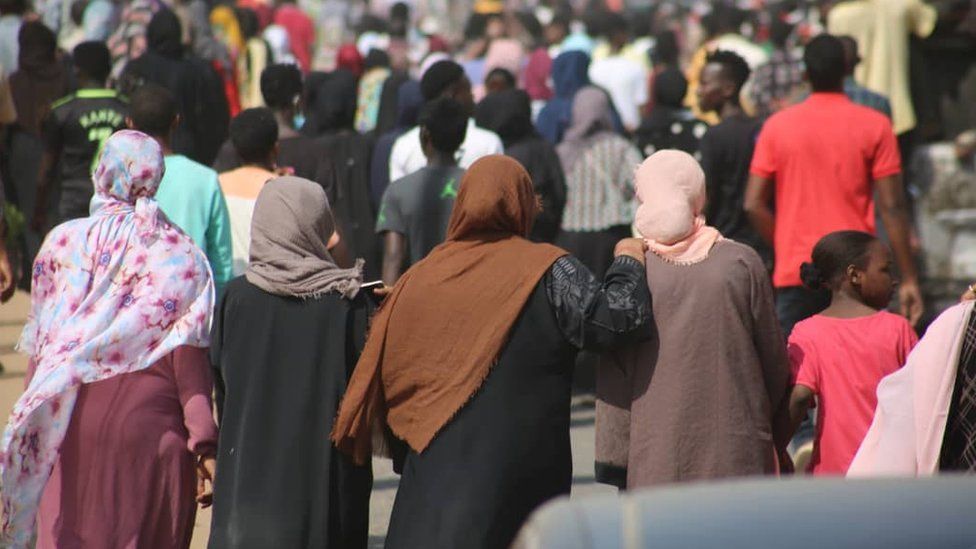
Protesters took to the streets after the military dissolved the civilian government, arrested political leaders and declared a state of emergency on Monday.
The troops reportedly went from house to house in the capital Khartoum, arresting the organizers of the local protest.
The coup was condemned worldwide and the United States blocked aid worth $ 700 million.
- IN THE PICTURES: The coup protesters in Sudan take to the streets
The leader of the coup, General Abdel Fattah Burhan, blamed internal political struggles for military action.
Civilian leaders and their military counterparts have been at odds since longtime ruler Omar al-Bashir was overthrown two years ago.
As Monday night fell, large numbers of protesters were on the streets of Khartoum – and other cities – demanding the return of the civilian government, reports BBC Arabic’s Mohamed Osman from the capital.
An injured protester told reporters that he was shot in the leg by the army outside military headquarters, while another man described the military firing first stun grenades, then live bullets.
“Two people died, I saw them with my own eyes,” said Al-Tayeb Mohamed Ahmed. Union of Doctors of Sudan e the information ministry also wrote on Facebook that the fatal shootings had taken place outside the military complex.
Pictures of a city hospital showed people in bloody clothes and various injuries.
Our correspondent says that despite the violence, the protests show little sign of easing.
Protesters blocked the streets with piles of bricks and burning tires. There are also many women who shout “no to the military government”.
The city’s airport is closed and international flights are suspended. The Internet and most of the telephone lines are also out of order.
Central Bank staff reportedly went on strike and doctors across the country refuse to work in military-run hospitals except in an emergency.
- Coup d’etat in Sudan: what you need to know
- Sound the alarm for the democracy of Sudan

World leaders reacted with alarm to news of the military takeover.
The US has joined the UK, the EU, the UN and the African Union, of which Sudan is a member, in calling for the release of political leaders who are now under house arrest in unknown locations.
Among them are Prime Minister Abdalla Hamdok and his wife, along with members of his cabinet and other civilian leaders.
Our correspondent said a special army security unit went to the prime minister’s home early Monday morning and tried to persuade Hamdok to accept the coup, but he refused.
Sudan has been involved in a power-sharing agreement between civilian and military leaders since longtime Governor Omar al-Bashir was overthrown in 2019.
- Why was Omar al-Bashir overthrown?
- Are military acquisitions on the rise in Africa?
The deal is designed to lead Sudan towards democracy, but it has been a tumultuous race with a series of previous coup attempts, the latest being just over a month ago.
General Abdel Fattah Burhan, who was in charge of the power-sharing agreement but is now leading the latest coup, said the takeover was necessary to “rectify the course of the revolution” due to political struggles. internal.
He said Sudan is still committed to the transition to civilian government, with elections scheduled for July 2023, but protesters did not accept his reasoning.




Are you in Sudan? Tell us your experience of recent events by sending an email to: haveyoursay@bbc.co.uk.
Please include a contact number if you wish to speak to a BBC reporter. You can also get in touch in the following ways:
- Whatsapp: +44 7756 165803
- Tweet: @BBC_HaveYourSay
- Or fill out the form below
- Please read our terms and conditions and privacy policy
If you are reading this page and are unable to see the form, you will need to visit the mobile version of the BBC website to submit your question or comment or you can email us at HaveYourSay@bbc.co.uk. Please include your name, age and location in any posting.
Related topics
- Sudan crisis
- Sudan
- Khartoum
- Omar al-Bashir
-
The Sudanese military takes power in a coup
- Published
- 5 hours ago
-
Raise the alarm for Sudan’s democracy
- Published
- 5 days ago
-
Sudan blames the dark forces for the failed coup
- Published
- 21 September
-
Former Sudanese President Bashir on trial for 1989 coup
- Published
- 21 July 2020
Read More about World News here.
This Article is Sourced from BBC News. You can check the original article here: Source


