


Using virtual reality to treat pain and anxiety
by Rory Claydon
Wake up to the money, BBC Radio 5 Live
- Published
Sharing information
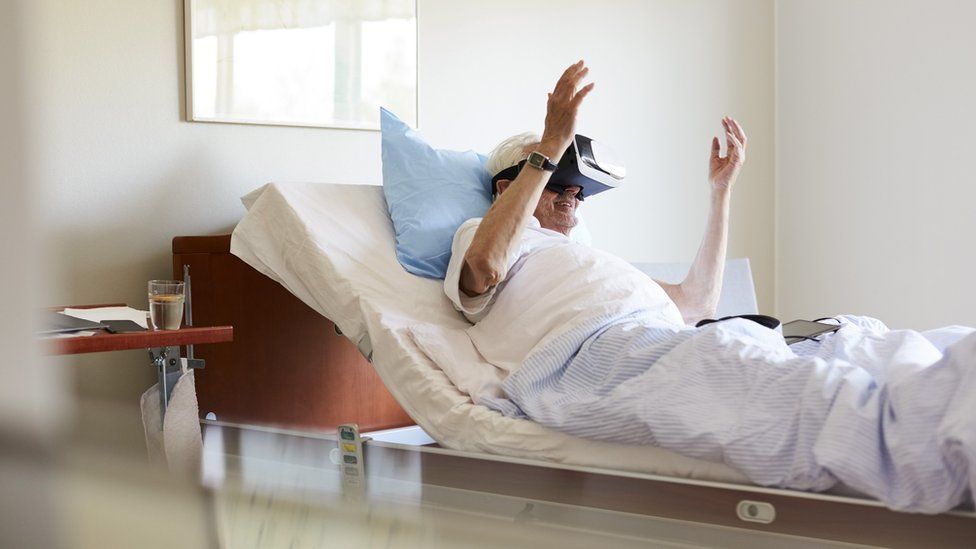
Following a hypoxic brain injury, Sarah Hill needed full-time care, but now virtual reality is opening up new worlds, from deep sea to deep space, all from the comfort of her nursing home.
“I am unable to walk and I can feel light and able to walk,” she says. “You can go under the sea, look at all these fish. It reduces my anxiety. I find the virtual reality kit very useful.”
After trials in multiple NHS agencies, the government says immersive technologies have the potential to “transform” therapy and healthcare.
- Prostate Cancer: AI pathologist used to aid diagnosis
- AI technology used to monitor asbestos cancer tumors
- VR headsets for work “could be an avalanche”
And the interventions tested, such as using virtual reality kits to treat pain and phobias, could save the NHS £ 2 million a year.
Ms. Hill’s physiotherapist Pamela Hicken says her VR kit “encourages movement” and interaction.
“I’ve had residents who can’t speak who are now talking to people or animals in the video,” he says.
Virtual reality has grown rapidly in the global healthcare industry.

Chief Executive Officer of the Welsh Government Life Sciences Center, Cari-Anne Quinn, says, “Immersive technologies are helping to future-proof our health and social care systems in Wales and beyond.”
And Oxford VR founder Professor Daniel Freeman, who supported the government’s National Institute for Health Research, tells BBC News: “My opinion is that it will play a major role in the future, thanks to the positive results we are seeing.” .
“It was arcade”
Rescape Innovation CEO Matt Wordley is also excited about the potential of the technology.
“Framing it like a video game, we’re in the arcade era,” he says.
“What’s going to happen is going to be phenomenal.
“But the challenges are always present.
“The NHS never had a budget for virtual reality, for example.”
But the Covid-19 pandemic has accelerated the adoption of immersive technology.
“The pandemic has shown that some things can be done quickly in the NHS when some barriers are broken,” says Wordley.
“We are having more positive conversations now.”
Potential problems
Overall, the virtual reality industry is projected to reach a value of $ 1.2 billion (£ 900 million) globally by 2024.
According to the communications regulator, Ofcom, one in 17 households in the UK had a VR headset in early 2020.
And the company Statista estimates that 6.1 million will have been sold by the end of 2021.
But some experts warn of the risks.
A report from VR companies and government, The Growing Value of Extended Reality in the UK, has identified potential problems, including nausea and fatigue, if the technology is poorly designed.
Related topics
- Assistive technology
- Virtual reality
-
How virtual reality helps recruit and train staff
- Published
- August 20
-
VR headsets for work “could be an avalanche”
- Published
- March 11th
-
Virtual reality helps parents visualize the child’s surgery
- Published
- November 23
-
Facebook’s metaverse plans labeled “dystopian”
- Published
- November 4th
Read More about Tech News here.
This Article is Sourced from BBC News. You can check the original article here: Source


